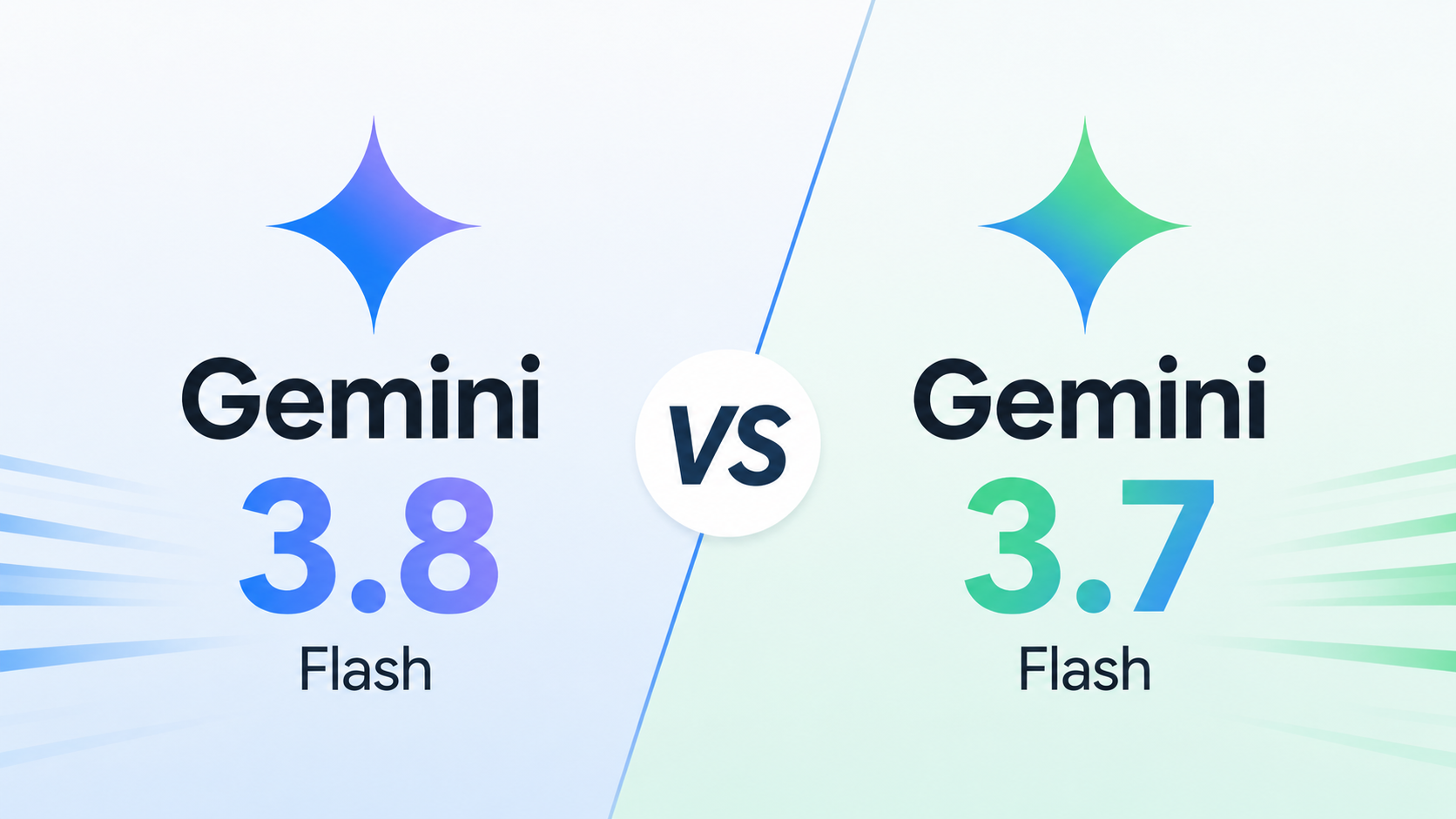
Gemini 3.8 Flash vs 3.7 Flash: Same Price, Different Bill

By Nathan Cole
MyClaw Editorial
MyClaw
Run Best-in-Class AI Agents Now
Run OpenClaw or Hermes Agent on managed MyClaw hosting, so your AI agent stays online, updated, and ready for real work.
Start HostingAI Takeaway
- Which should you pick first? Gemini 3.8 Flash for new long-horizon coding and agent jobs. Keep Gemini 3.7 Flash when the job is efficiency-first and already passing.
- Is this a cheaper upgrade? No. Both list $0.75 / $3.75 per 1M tokens through 31 December 2026, then $1.50 / $7.50 on 1 January 2027. 3.8 Flash often spends more tokens because it works harder.
- Same window? Yes on the public model pages: 1,048,576 input / 65,536 output. Text, image, video, audio, and PDF in; text out.
- Should you drop 3.7? Google still supports it for efficiency-first workloads. Measure cost per finished job, not the sticker.
The Matchup Is 3.8 Flash Against 3.7 Flash
Gemini 3.7 Flash shipped 13 August 2026 as gemini-3.7-flash. Gemini 3.8 Flash shipped 2 September 2026 as gemini-3.8-flash. That is Google's third Flash drop in six weeks, at the same introductory rate.
If a roundup still treats 3.7 Flash as the current workhorse, the Flash side is already a generation behind. The older workflow still holds. Swap the model ID. Do not fall back to a 3.6 comparison unless that is the ID you still run in production.
Google positions 3.8 Flash as the most intelligent Flash workhorse: software engineering, agentic tasks, and multi-step reasoning in specialized domains. 3.7 Flash remains fully supported for efficiency-first workloads. Gemini 3.8 Flash Cyber is a Fairwind Program variant for trusted defenders. Public Flash work stays on gemini-3.8-flash or gemini-3.7-flash.
What 3.7 Flash Is For
3.7 Flash is the Flash you should keep when a workflow already passes. The Gemini 3.7 Flash review covers plan limits, thinking levels, and the 13 August launch. Use it for high-volume loops where token count and latency dominate, or when a controlled regression still prefers the older ID.
Official docs list the same envelope 3.8 later kept: 1,048,576 input tokens, 65,536 max output, multimodal input, text output. Caching, function calling, file search, and code execution are supported. Computer use is preview.

What 3.8 Flash Is For
3.8 Flash is the escalate inside the Flash line, not a different price tier. Official docs call it the most intelligent Flash model, engineered for long-horizon software engineering, autonomous agents, and complex enterprise workflows, at Flash speed and cost.
Google says the gains come from a design choice: 3.8 Flash works harder. On complex tasks it runs extra reasoning steps and calls tools iteratively, especially at higher effort, and may use more tokens to maximize performance.
On MyClaw there is no 3.7 or 3.8 model page yet. The live Flash listing is still Gemini 3.5 Flash. Run the IDs the provider actually exposes, and write down any substitution.
Specs at a Glance
Official Gemini API model pages plus the 2 September 2026 launch post, checked 3 September 2026. Regional, batch, Flex, and contract rates can differ.
| Gemini 3.7 Flash | Gemini 3.8 Flash | |
|---|---|---|
| Role | Efficiency-first Flash | Current Flash workhorse |
| API ID | gemini-3.7-flash | gemini-3.8-flash |
| Status | Stable (Aug 2026) | Stable (Sep 2026) |
| Context / max output | 1,048,576 / 65,536 | 1,048,576 / 65,536 |
| Intro API price (through 31 Dec 2026) | $0.75 in / $3.75 out | $0.75 in / $3.75 out |
| Standard price from 1 Jan 2027 | $1.50 / $7.50 | $1.50 / $7.50 |
| Thinking | low, medium, high | low, medium, high |
| First use | Jobs that already pass on 3.7 | New long-horizon coding and agents |
| Caveat | Previous generation, still supported | Same sticker, often more tokens |
Same Sticker. Cost Per Finished Job Can Rise
On list price, the two models are identical: $0.75 input and $3.75 output per million tokens through 31 December 2026, then $1.50 / $7.50 on 1 January 2027. If 3.8 Flash finishes the same work in the same tokens, there is no reason to stay on 3.7. Google is not promising the same token count.
The upgrade is diligence, not a discount. Extra reasoning steps and extra tool turns show up as output tokens. A verbose agent loop can erase the "same price" story even when the rate card does not move. Count tokens, retries, and leftover cleanup on one closed ticket. That total is the comparison. The list price is only the rate.
Independent cost-per-task currently favors that reading. Artificial Analysis puts Gemini 3.8 Flash around 59 on the Intelligence Index versus about 56 for 3.7 Flash, and prices those runs at about $0.58 versus $0.40 per task. Treat those dollars as a directional signal, not your production invoice. Your harness will move the bill more than a leaderboard average.
The older Gemini 3.7 Flash vs 3.6 Flash piece is still useful on how to run a side-by-side. Keep the files and the pass/fail rule. Swap in the 3.8 ID.
Coding and Agents: Upgrade Where 3.7 Already Stalled
Use 3.8 Flash for the work 3.7 Flash already left messy: multi-hour coding, terminal agents, and multi-step research that has to stay coherent. If 3.7 already closes the ticket with little cleanup, 3.8 has nothing to prove on that job. Google's launch pitch concentrates there: DeepSWE v1.1 long-horizon engineering, finance and legal agent benches, and 54.9% on HLE-Verified. Those are vendor scores. They are a reason to test 3.8 on your hardest Flash jobs, not to put it on every autocomplete.
Use 3.7 Flash when the job is repeated, testable, and budget-sensitive, and when a high-thinking 3.8 pass would only add tokens. Everyday patches can look closer than the long-horizon table. If a bounded unit-tested change already closes on 3.7, keep 3.7. Do not migrate a stable loop because the version number moved three weeks later.
If the split is Gemini Flash versus a frontier Claude, the Gemini 3.7 Flash vs Opus 5 post is the older cross-family page. This page stays inside Flash: current workhorse versus efficiency-first previous generation.
Controls That Change the Bill
Both models support thinking at low, medium, and high. minimal returns an error. Compare them at the same level so extra tokens are the model, not a knob change. high buys coverage. low buys throughput. If efficiency is the constraint, drop the thinking level on 3.8 Flash, or keep 3.7 Flash. Google still points efficiency-first workloads at 3.7.
Run the Same Flash Job on Both Models
The model stops if the laptop sleeps, the terminal dies, or the files live in another chat. OpenClaw is the runtime: channels, tools, memory, and scheduled jobs. The model is only the reasoning layer. MyClaw hosts that runtime so the workspace stays up while you swap Flash IDs.
Step 1: Freeze one real Flash job
Pick a single outcome: a failing test, a bounded refactor, a sourced research memo, or a scheduled monitor. Prefer a job you already ran on 3.7 Flash. Write the pass/fail rule before either model starts.
Step 2: Run 3.7 Flash, then 3.8 Flash at the same thinking level
Keep files, tools, permissions, and instructions identical. First pass is 3.7 Flash. Second pass is 3.8 Flash when the ID is actually available; otherwise stay on 3.7 and record the substitution. Track tokens, retries, leftover cleanup, and whether the ticket closed.
Step 3: Keep the hosted workspace so you can switch
Leave logs, diffs, notes, and artifacts in the same hosted workspace. The next run should start from the work, not a blank chat. MyClaw pricing covers the always-on host. Model tokens still bill separately.
Pick by Job Shape, Then Keep a Fallback
| If you need… | Start with… |
|---|---|
| New long-horizon coding or agent loops | Gemini 3.8 Flash |
| Efficiency-first jobs that already pass | Gemini 3.7 Flash |
| Lower token overhead on 3.8 | 3.8 Flash at a lower thinking level |
| Overnight / always-on execution | A hosted OpenClaw workspace, then swap the model |
Keep a cheaper backup and three to five jobs you re-run when prices or model IDs move. Default to 3.8 Flash for new long-horizon Flash work. Keep 3.7 Flash when efficiency is the job. Change the model. Leave the workspace alone.
Skip the Setup, Run Best-in-Class AI Agents Now
Launch a managed OpenClaw or Hermes Agent workspace in minutes, with always-on hosting, updates, and support handled by MyClaw.
Get Started