GLM 5.3 Flash vs GLM 5.3: Which Model Should You Use?

By Nathan Cole
MyClaw Editorial
MyClaw
Run Best-in-Class AI Agents Now
Run OpenClaw or Hermes Agent on managed MyClaw hosting, so your AI agent stays online, updated, and ready for real work.
AI Takeaway
- Which model is better overall? GLM 5.3 remains the safer first test for the hardest text-only coding and long-horizon engineering tasks. GLM 5.3 Flash is the stronger default for high-volume agent work, visual workflows, and cost-sensitive production use.
- How much cheaper is Flash? During Z.AI’s promotion, Flash input and output are roughly 18.7x and 17.6x cheaper. At standard list prices, they remain about 9.3x and 8.8x cheaper.
- Is GLM 5.3 clearly better at coding? No. Z.AI reports that it leads several demanding coding and reasoning benchmarks, while Flash stays close and wins selected tool-use and automation tests.
- What is the biggest capability difference? Flash accepts images, videos, and files and has released MIT weights. GLM 5.3 is text-only, and its official checkpoint was still unavailable on August 27, 2026.
- Which should an OpenClaw agent use? Start with Flash, then reserve GLM 5.3 for workloads where testing proves that its extra reasoning quality improves accepted outcomes.
GLM 5.3 Flash vs GLM 5.3 at a Glance
| Category | GLM 5.3 Flash | GLM 5.3 |
|---|---|---|
| Positioning | Efficient multimodal coding and agent model | Flagship text-first engineering and agent model |
| Input | Text, images, video, and files | Text only |
| Context window | 1M tokens | 1M tokens |
| Maximum output | Up to 128K tokens | Up to 128K tokens |
| Reasoning | Always enabled; low, high, and max effort | Always enabled; low, high, and max effort |
| API price per 1M tokens | $0.15 input / $0.03 cached / $0.50 output; temporarily 50% lower | $1.40 input / $0.26 cached / $4.40 output |
| Weight access | Released under MIT | Official checkpoint not yet available as of August 27, 2026 |
| Best fit | Frequent runs, visual tasks, automation, and cost control | Difficult text engineering, deep debugging, and high-value long tasks |
Flash offers much of the flagship’s coding and agent capability at roughly one-tenth of the standard API price while adding visual input. GLM 5.3 earns its premium when difficult text work benefits from stronger reasoning. The GLM 5.3 vs GLM 5.2 comparison explains its post-training gains.
Coding and Agent Performance: How Large Is the Gap?
GLM 5.3 Leads the Hardest Text-First Work
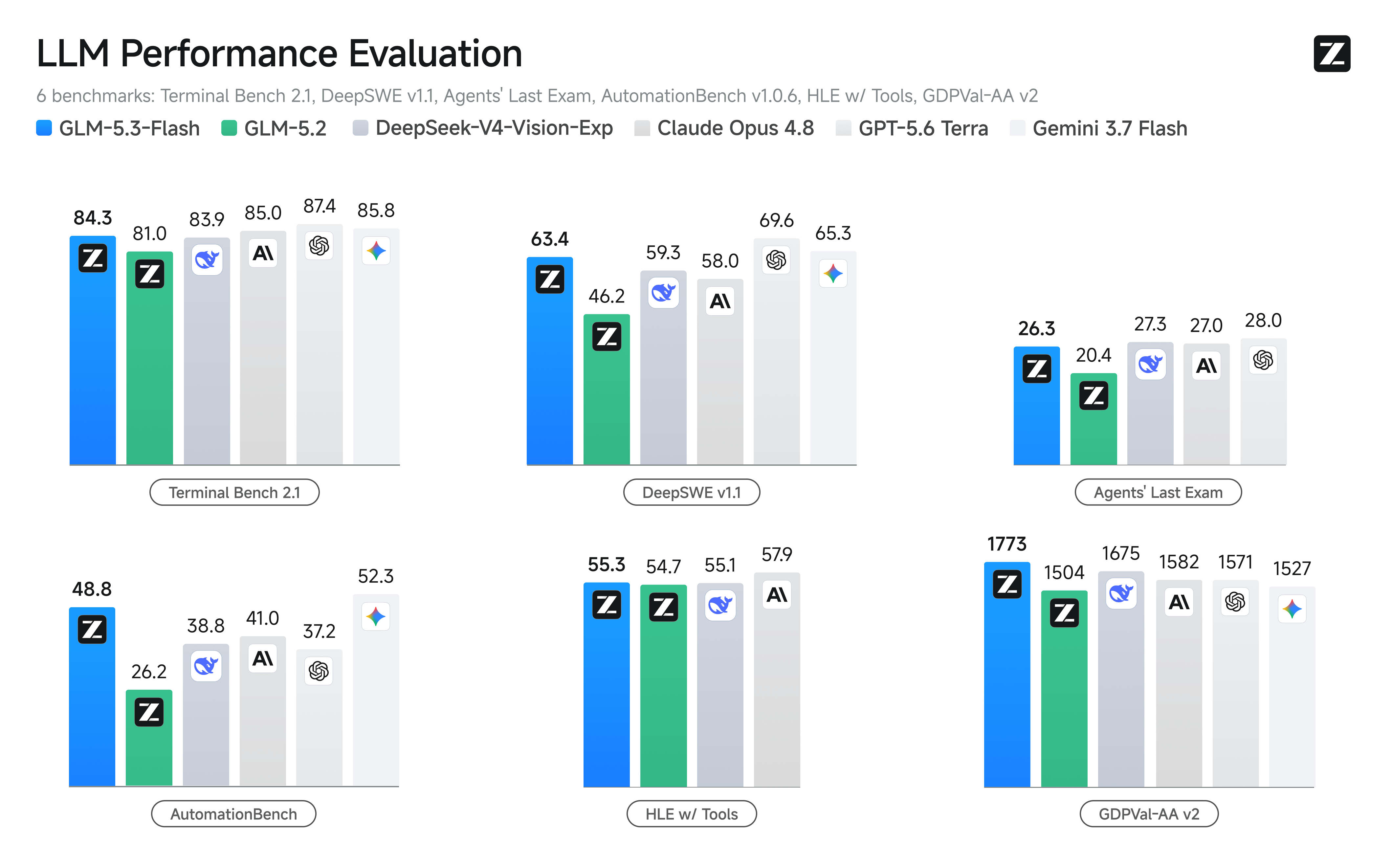
Z.AI’s separate launch tables give GLM 5.3 the advantage on several demanding coding and reasoning tests:
| Benchmark | GLM 5.3 Flash | GLM 5.3 |
|---|---|---|
| Terminal-Bench 2.1 | 84.3 | 88.2 |
| DeepSWE v1.1 | 63.4 | 66.9 |
| Agents’ Last Exam | 26.3 | 28.5 |
| HLE with tools | 55.3 | 62.5 |
| Toolathlon Verified | 78.4 | 73.0 |
| AutomationBench | 48.8 | 48.2 |
| GDPval-AA v2 | 1773 | 1769 |
The flagship’s clearest advantages appear in long coding trajectories and difficult reasoning. Start there for repository-scale changes, multi-stage debugging, terminal-heavy engineering, and authorized defensive security analysis. Z.AI has also published dedicated cyber results for GLM 5.3, while equivalent Flash results are unavailable.
These are vendor-reported comparisons, not an independent head-to-head test. Effort, harness versions, timeouts, and token budgets can change results. The GLM 5.3 vs Opus 4.8 analysis illustrates the same issue.
Flash Is Competitive—and Sometimes Ahead—in Tool Use
Flash trails by fewer than four points on Terminal-Bench 2.1 and DeepSWE, yet leads Toolathlon Verified by 5.4 points. Its AutomationBench and GDPval-AA results are also marginally higher—a strong trade when tokens cost dramatically less.
Flash also handles work the flagship cannot accept directly: screenshots, rendered interfaces, charts, scanned pages, and video. A frontend agent can implement a reference design and visually inspect its result without handing images to another model. That may matter more than a modest text benchmark lead.
A Benchmark Win Is Not the Same as a Cheaper Accepted Result
The highest-scoring model can still be worse in production if it generates more tokens, retries tools, or needs human cleanup. Evaluate quality, elapsed time, tool failures, retries, token use, and repair time together.
Use the OpenClaw AI Model Benchmark as another real-world signal, then test your exact workflow. A small benchmark advantage has little value if the cheaper model passes just as often.
Price, Speed, Context, and Deployment
Flash Costs About One-Tenth as Much at List Price
Z.AI lists Flash at $0.15 per million input tokens, $0.03 cached, and $0.50 output. A 50% promotion lowers these to $0.075, $0.015, and $0.25 until 24:00 UTC+8 on September 9, 2026. GLM 5.3 costs $1.40, $0.26, and $4.40.
Ten million fresh input tokens and two million output tokens cost about $1.25 with promotional Flash pricing, $2.50 at list price, or $22.80 with GLM 5.3. The flagship must prevent meaningful rework to recover the difference.
These are API charges. MyClaw hosting plans cover the managed runtime—private server, uptime, updates, and operations—while token charges pay for inference.
Lower Compute Does Not Guarantee Lower End-to-End Latency
Flash combines sparse and linear attention. Z.AI says this reduces attention computation by about 3.0x and KV-cache size by 4.4x versus GLM 5.3. That lowers long-context serving cost, not necessarily response time by the same factor.
Speed also depends on hardware, load, batching, reasoning effort, tool calls, and output length. The flagship may finish sooner if it avoids retries. Measure time to an accepted result, not only time to first token.
Both Offer 1M Context, but Only Flash Sees Visual Inputs
Both models support a one-million-token context window, up to 128K output, and always-on reasoning with low, high, or max effort. Matching limits do not guarantee matching recall or goal retention across long tool-driven runs.
Modality is the sharper distinction. GLM 5.3 accepts text, code, logs, and tool output. Flash also interprets images, video, and files. Choose Flash when screenshots, charts, visual documents, UI inspection, or computer use are routine.
Open Weights Change the Deployment Decision
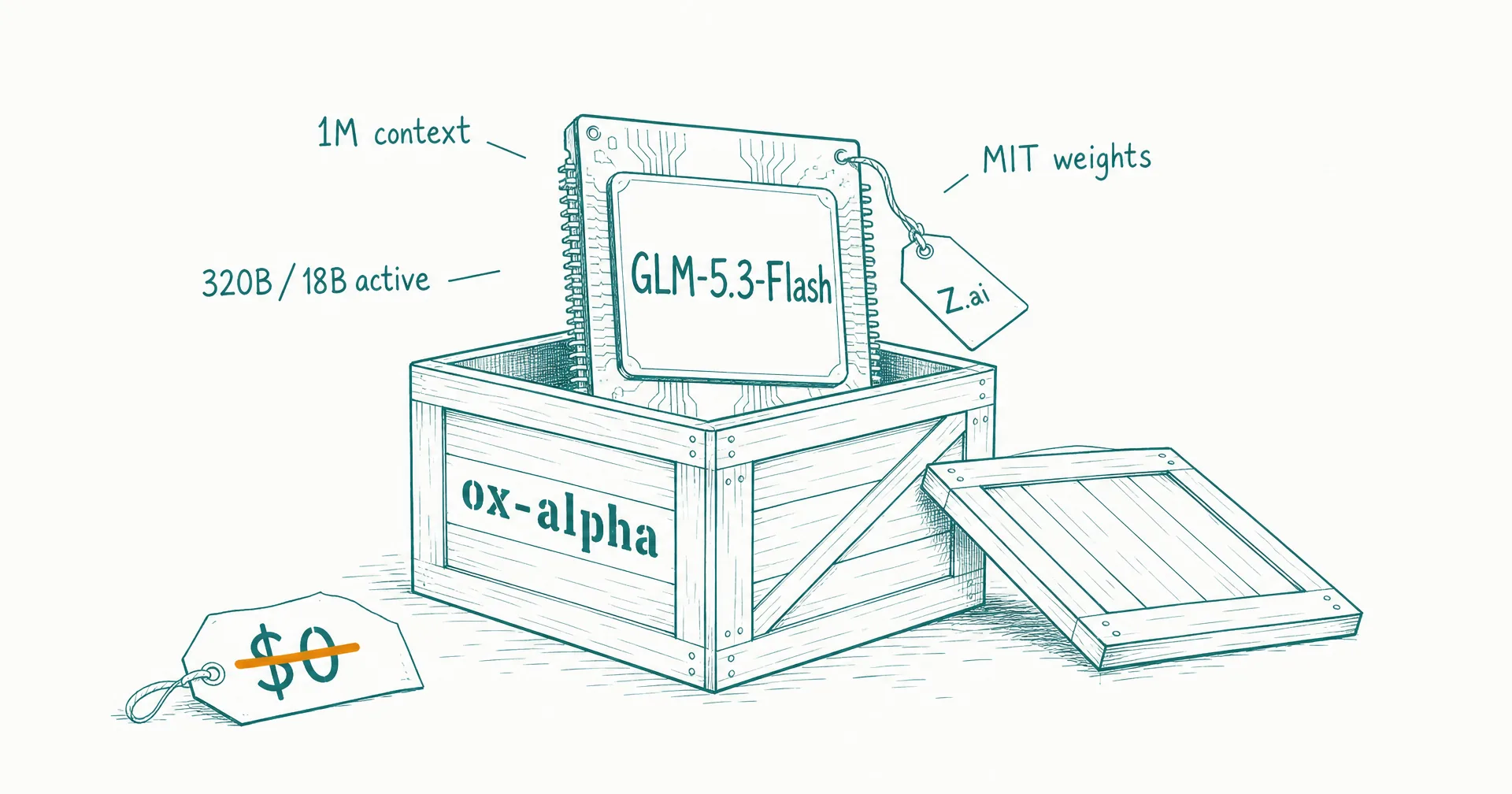
Flash has released MIT-licensed weights with support for SGLang, vLLM, and TokenSpeed. It is still a 320B-total, 18B-active mixture-of-experts model, so self-hosting requires substantial accelerators, memory planning, monitoring, and inference expertise.
Z.AI had not published the official GLM 5.3 checkpoint by August 27, 2026. Flash is therefore the practical choice when downloadable weights are mandatory. API users can test either model without operating frontier-scale infrastructure.
Which Model Should You Choose?
Choose GLM 5.3 Flash for High-Volume and Multimodal Work
Start with Flash for routine coding, repeated agent loops, document processing, screenshot debugging, UI verification, and budget-sensitive automation. Choose it when you need released weights or one model for code and visual evidence.
Choose GLM 5.3 for the Hardest Text-Only Engineering
Start with GLM 5.3 for complex repository changes, extended terminal execution, deep debugging, performance investigations, and authorized security review. Its premium makes sense when failures are expensive and a capability edge prevents hours of repair.
Route Work Across Both Models When the Task Mix Varies
Use Flash for the broad, frequent lane, then escalate failed or unusually difficult text tasks to GLM 5.3. The flagship can also review critical Flash results.
This keeps cost predictable without losing top-end reasoning. If neither fits, the MyClaw AI model directory compares other options by context, capability, and workflow fit.
Test Both Models in an Always-On MyClaw Agent
 Managed OpenClaw hosting provides a persistent workspace, keeping infrastructure changes out of the model comparison.
Step 1: Freeze One Real Workflow
Choose a representative task with a pass-or-fail outcome. Keep the repository version, files, tools, memory, permissions, prompt, time limit, and acceptance checks identical.
Step 2: Run Both Models Under the Same Conditions
Confirm that the provider exposes both exact model IDs, then use comparable reasoning settings. Test a repository task and a tool-heavy workflow; add a visual task when deciding whether Flash’s multimodal input changes the result.
Step 3: Route Work by Accepted Results
Record pass rate, retries, latency, tokens, provider cost, and human repair time. Make Flash the default where it passes reliably, and pay for GLM 5.3 only in lanes where it produces measurably better finished work.
Final Verdict: Start With Flash, Escalate the Hardest Work
GLM 5.3 Flash is the better first test for most cost-sensitive teams. It stays close on important coding tests, leads selected tool-use benchmarks, supports visual inputs, offers MIT weights, and costs about one-tenth as much.
Use GLM 5.3 for difficult text-first engineering where stronger long-horizon reasoning improves results. Keep test conditions fixed, measure accepted work, and let each workload earn its model.
Skip the Setup, Run Best-in-Class AI Agents Now
Launch a managed OpenClaw or Hermes Agent workspace in minutes, with always-on hosting, updates, and support handled by MyClaw.