GPT-6.1 Sol for Coding: Benchmarks, Effort Settings and Cost per Task

By Nathan Cole
MyClaw Editorial
MyClaw
Run Best-in-Class AI Agents Now
Run OpenClaw or Hermes Agent on managed MyClaw hosting, so your AI agent stays online, updated, and ready for real work.
AI Takeaway
- Is GPT-6.1 Sol a strong pick for coding work? Yes, with limits. It scores 56.1% on Terminal-Bench 4.0, behind Kimi K3.1 Pro (67.2%) and Opus 5.5 (59.6%), but ahead on price per task (Artificial Analysis, independent, Oct 26, 2026).
- Where does its coding benchmark edge come from? Cost. One Terminal-Bench 4.0 task costs $1.82 on GPT-6.1 Sol versus $13.11 on Opus 5.5 and $8.50 on GPT-6 Astra, max effort (independent, Oct 26, 2026).
- Which reasoning effort should coders start with? Medium, then test high. Medium is the default, and OpenAI's DeepSWE chart appears to show high scoring at or above max, though we could not confirm exact values from its text (OpenAI, Sep 29, 2026).
- Do OpenAI's coding claims match outside tests? Partly. OpenAI says Sol matches GPT-6 Astra on DeepSWE v1.1, while independent Terminal-Bench 4.0 puts it three points behind Astra (OpenAI, Sep 29; Artificial Analysis, Oct 26, 2026).
- How can I keep a GPT-6.1 Sol coding agent working on scheduled jobs? Run it on MyClaw. It keeps OpenClaw and Hermes coding agents live day and night, runs recurring jobs and needs no server setup (MyClaw, Oct 26, 2026).
What OpenAI Says About GPT-6.1 Sol for Coding
OpenAI released GPT-6.1 Sol on September 29, 2026 as the middle model of its GPT-6 family. The launch post claims it nearly equals GPT-6 Astra on agentic coding while charging one-fifth of Astra's token prices.
For coding, OpenAI leans on one benchmark: DeepSWE v1.1, which tests long-horizon software engineering tasks in real codebases. The vendor-stated claims are:
- GPT-6.1 Sol matches GPT-6 Astra on DeepSWE v1.1 at roughly one-fifth of the cost (OpenAI, Sep 29, 2026).
- It beats GPT-6 Sol's best DeepSWE score by 6.4 percentage points, at a lower reasoning effort and cost (OpenAI, Sep 29, 2026).
- On Terminal-Bench Science 0.1 at max effort it averages $5.47 per task, against $23.21 for Opus 5.5 and $23.80 for Astra (OpenAI, Sep 29, 2026).
OpenAI does not publish SWE-bench Verified or SWE-bench Pro scores for this model, so classic leaderboard comparisons have to come from third parties.
The practical specs matter just as much for coding agents. Per OpenAI's model page (checked Oct 26, 2026), GPT-6.1 Sol lists a $2 input rate, a $10 output rate (each per million tokens), $0.10 cached input and $2.50 cache writes. Past the 272K input mark, the entire call moves to double input and cache pricing plus 1.5x on output. Context reaches 1.05M tokens and a single reply can hit 128K. Tool calling runs through the Responses API only, and the model is available in Codex for paid ChatGPT plans. For the launch details, see our GPT-6.1 Sol overview.
Independent Coding Benchmark Results for GPT-6.1 Sol
For a like-for-like check we use Artificial Analysis, which tests each model with one shared setup. Terminal-Bench 4.0 there covers 66 terminal tasks with the mini-swe-agent harness, scored pass@1 and averaged over three runs. All rows below are independent results checked Oct 26, 2026, at max effort unless marked.
| Model | Terminal-Bench 4.0 | Cost per Terminal-Bench task | SciCode | FrontierCode (AA run) |
|---|---|---|---|---|
| GPT-6.1 Sol | 56.1% | $1.82 | 54.2% | 49.1% |
| GPT-6 Astra | 59.1% | $8.50 | 56.5% | 47.0% |
| Opus 5.5 | 59.6% | $13.11 | 66.9% | 52.2% |
| Sonnet 5.5 | 63.6% | $12.65 | 61.0% | 45.8% |
| Kimi K3.1 Pro | 67.2% | $5.27 | 60.8% | 47.1% |
| Gemini 4 Argon (high) | 57.1% | $6.78 | 61.8% | 43.5% |
Three things stand out. First, GPT-6.1 Sol is not the top scorer on any of these coding tests. Kimi K3.1 Pro leads Terminal-Bench 4.0 by 11.1 points, and Opus 5.5 leads both SciCode and FrontierCode.
Second, the price gap is far larger than the score gap. By our arithmetic from the table, Opus 5.5 costs about 7.2x more per Terminal-Bench task than GPT-6.1 Sol for 3.5 more points, and Astra costs about 4.7x more for 3.0 more points. Kimi K3.1 Pro costs about 2.9x more but also scores the most.
Third, FrontierCode is a relative strength. At 49.1% in the Artificial Analysis run, GPT-6.1 Sol sits second behind Opus 5.5 and ahead of Astra. Cognition publishes its own FrontierCode figures that differ from these, so always check which source a number comes from. Our Sol and Opus 5.5 head-to-head goes deeper.
Where GPT-6.1 Sol Fits in a Coding Workflow
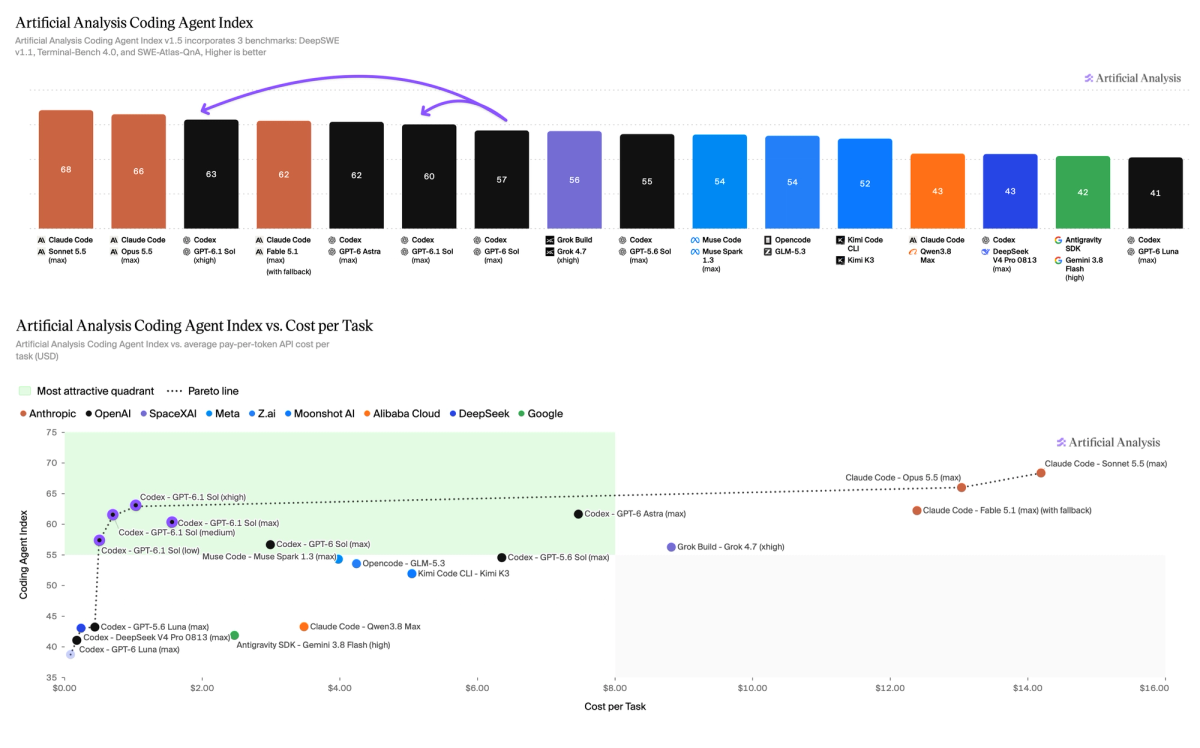
GPT-6.1 Sol suits coding work where volume and budget outweigh a few extra points of accuracy.
It fits well for:
- Agent loops with many runs. At $1.82 per Terminal-Bench task (independent, Oct 26, 2026), several retries of a failed task still total less than one Opus 5.5 attempt.
- Test-driven fixes. With a test suite as the judge, the agent can loop until green.
- Repository-scale context. The 1.05M-token window holds large codebases, as long as you watch the 272K pricing threshold (OpenAI, Oct 26, 2026).
It fits less well for:
- Scientific and numerical code. Its SciCode score of 54.2% is the lowest in our table, 12.7 points under Opus 5.5 (independent, Oct 26, 2026).
- Interactive pair programming at max effort. The first token took 246.63 seconds, about four minutes, in Artificial Analysis testing. Terminal-Bench tasks averaged 1736 seconds of decode time, about 29 minutes each by our arithmetic, excluding that wait.
If the trade-offs point you to another model, compare it against the bigger sibling in GPT-6.1 Sol vs GPT-6 Astra, or browse our list of Opus 5.5 alternatives ranked by cost per task.
Choosing an Effort Setting for Coding Tasks
OpenAI lists five reasoning efforts for GPT-6.1 Sol, from low up to max, and medium is the default (OpenAI model page, Oct 26, 2026). The none and minimal settings from GPT-6 Sol are gone, so older integrations need an update.
Effort is your biggest cost dial. The independent figures above use max, which produced about 108K output tokens per Terminal-Bench task. Lower settings usually spend fewer tokens and respond sooner.
OpenAI's DeepSWE v1.1 chart appears to show high effort scoring at or above xhigh and max. A third-party transcription lists 75.2% at high and 71.9% at max, but we could not confirm those exact values from OpenAI's text, so treat them as indicative only.
A sensible starting plan:
- Start at medium for routine edits, refactors and code review.
- Move to high for multi-file changes and harder bugs, and compare pass rates.
- Reserve xhigh or max for long terminal tasks where the extra wait and tokens pay off.
- Log the model and effort on every run to trace what moved a result.
Run a GPT-6.1 Sol Coding Agent on MyClaw
Long tasks and slow first tokens change how you run a coding agent. A half-hour job needs a home that keeps going once your laptop sleeps.
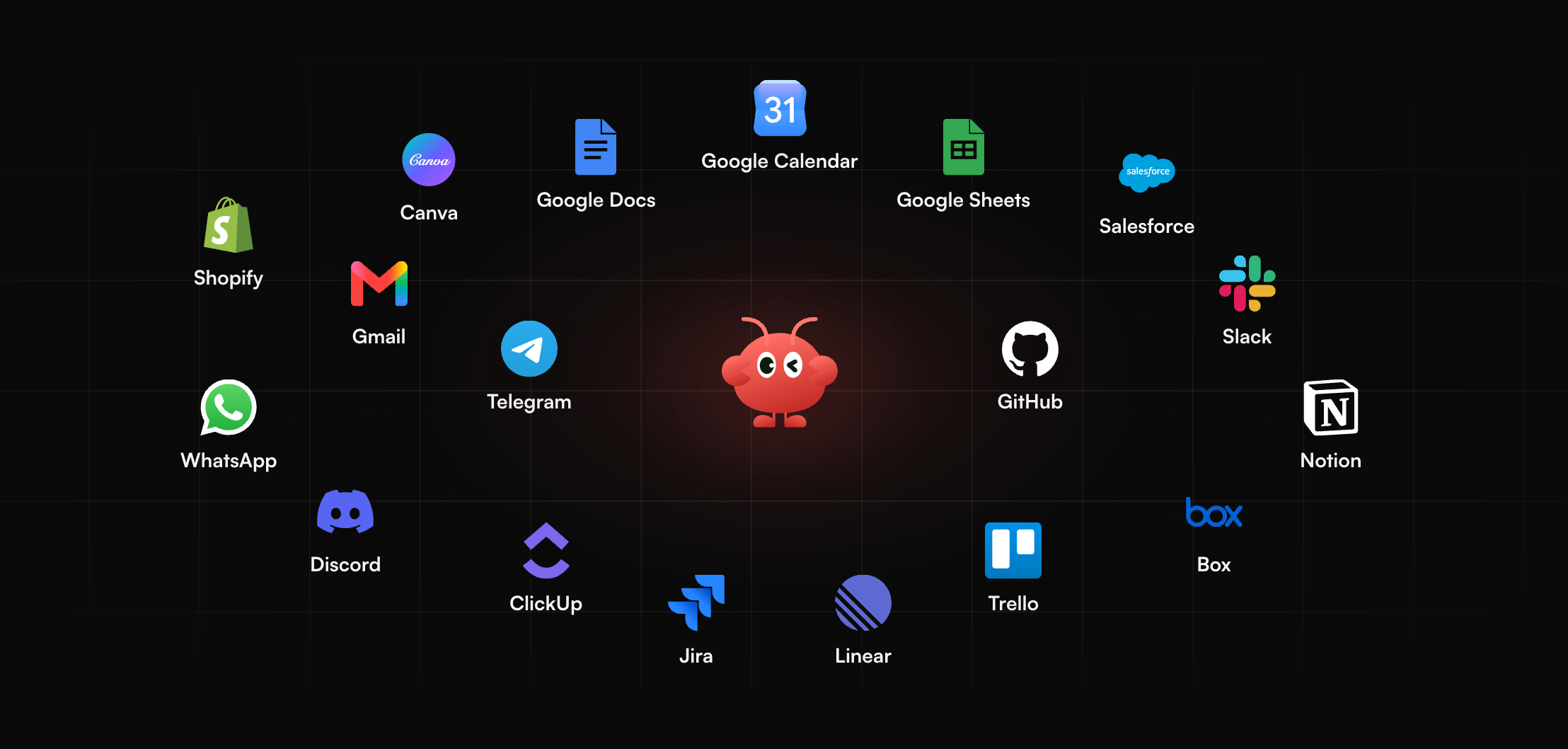
That is what MyClaw is for: a managed service that hosts your OpenClaw or Hermes agents, and GPT-6.1 Sol is available as its model. The agent stays always on, takes scheduled and recurring jobs like nightly test runs, dependency checks or issue triage, and you never touch a server. Swapping models later needs no rebuild, since MyClaw already works with most popular models. For background on both agents, see our OpenClaw primer and the Hermes overview.
- Open MyClaw in a browser and register.
- Choose OpenClaw or Hermes, then select GPT-6.1 Sol as the model.
- Describe the first coding job, set a schedule and let it run.
A Quick Test Plan Before You Switch
Benchmarks narrow the field, but your own repository decides. Run a short, fair trial first:
- Pick five to seven real tasks: a couple of bounded bugs, a couple of multi-file changes, one long-context question and one task where an out-of-scope edit counts as a failure.
- Keep the prompt, tools, repository commit and tests fixed across the models you compare.
- Run medium and high effort as separate experiments, not mixed.
- Record accepted fixes, regressions, wall-clock time and dollars per accepted fix.
If GPT-6.1 Sol lands within a few points of your current model while costing far less per accepted fix, move most of your coding volume to it.
Conclusion: GPT-6.1 Sol Is a Cost-First Coding Model
GPT-6.1 Sol is a capable coding model rather than the best-scoring one. Independent tests put it at 56.1% on Terminal-Bench 4.0 and second on FrontierCode, while SciCode is a weak spot (Artificial Analysis, Oct 26, 2026). Its real advantage is cost: $1.82 per Terminal-Bench task, against $8.50 for Astra and $13.11 for Opus 5.5. Start at medium effort, test high on harder work, and trial it on your own repository. For high-volume agent work, few models deliver this much coding per dollar.
Skip the Setup, Run Best-in-Class AI Agents Now
Launch a managed OpenClaw or Hermes Agent workspace in minutes, with always-on hosting, updates, and support handled by MyClaw.