GPT-6 Cyber Review: Access, Pricing and Who Can Use It

By Nathan Cole
MyClaw Editorial
MyClaw
Run Best-in-Class AI Agents Now
Run OpenClaw or Hermes Agent on managed MyClaw hosting, so your AI agent stays online, updated, and ready for real work.
AI Takeaway
- What is GPT-6 Cyber? OpenAI’s cyber-specialized variant of GPT-6 Astra, with extra post-training for authorized vulnerability research and fix validation. The API ID is
gpt-6-cyber. - Is it still a preview? No. September reports of an OpenAI GPT-6 Cyber preview described a model that had not launched yet. OpenAI introduced it on 5 November 2026 as a restricted release. The documented ID is
gpt-6-cyber, not a-previewname, and it is not generally available. - Who can use it? Approved Daybreak Red organizations with separate approval for this model, initially through the API and Codex. Daybreak Red approval alone is not enough. Individuals can apply for Daybreak Blue; they cannot generally apply for Red.
- What does it cost? Official Standard short-context list rates are $20 per million input tokens and $100 per million output tokens, with $2 cached input. Long-context and cache-write rates are higher. This is not a free model.
- Can you run GPT-6 Cyber on MyClaw? Not confirmed. MyClaw does not list a GPT-6 Cyber model page. Use MyClaw Chat for everyday writing, research, and coding on models that are actually available.
What GPT-6 Cyber Is (and Is Not)
GPT-6 Cyber is OpenAI’s specialized cybersecurity model, built as a variant of GPT-6 Astra with additional post-training. OpenAI positions it for authorized security work, such as investigating a vulnerability in an approved environment or verifying a fix. The API identifier is gpt-6-cyber.
That design differs from GPT-6 Rosalind. For its life-sciences Research release, OpenAI said Rosalind uses Astra weights with no extra training or post-training. Cyber is a specialized variant, not the same weights under a new name. It is also not a ChatGPT Free or Plus default, and not a general-purpose replacement for Astra. For the parent flagship’s pricing, specs, and everyday agent uses, start with the GPT-6 Astra review.
Preview vs Launch: What Changed After September
Searches for an “OpenAI GPT-6 Cyber preview” still reflect late-September 2026 reporting that OpenAI would preview the model within days. The official introduction is dated 5 November 2026. OpenAI presented GPT-6 Cyber as a restricted launch, initially available through the API and Codex to a select group of approved Daybreak Red customers.
The live API ID is gpt-6-cyber, not a -preview identifier. Do not confuse it with gpt-5.5-cyber-preview, an older model that OpenAI says remains only for existing approved access and retires on 1 February 2027. OpenAI says it will expand GPT-6 Cyber access to all Daybreak Red customers soon, but “soon” has no public date. GPT-5.6 Cyber is already available to all Daybreak Red organizations. Until that GPT-6 Cyber expansion is confirmed for your organization, treat the model as an approval-based launch, not general availability. If you need general GPT-6 work that does not require this gated ID, start with the GPT-6 Sol review.
Who Can Access GPT-6 Cyber
OpenAI’s Daybreak program is Trusted Access for Cyber. Daybreak Blue reduces refusals on supported mainline models for approved defensive work, but it does not include Cyber models. Daybreak Red is the path for advanced authorized work and is limited to approved business and enterprise organizations. Individuals can apply for Blue; they cannot generally apply for Red.
Even inside Red, access is layered. All Daybreak Red organizations are eligible for GPT-5.6 Cyber. GPT-6 Cyber needs a second, model-specific approval. Enabling a Red toggle, or selecting Red in an API request, does not switch the model. Use the approved model ID, and on the Responses API set access_programs.cyber to daybreak_red.
OpenAI names the API and Codex as the initial surfaces. Chat Completions and Responses are supported. ChatGPT can respect Daybreak workspace controls, but OpenAI recommends Codex, and this is not consumer self-serve access. Approval does not turn Daybreak on by itself: owners must enable approved users or non-default API projects, and Codex signed in with ChatGPT still needs the Daybreak control on.
Expect identity review, single sign-on, multi-factor authentication, and, by default, API IP allowlisting. Default API projects cannot enable Daybreak. If a project uses Zero Data Retention, OpenAI generally also requires Private Safety Processing. The program is for authorized work on systems you own, operate, or are explicitly allowed to test.
The trusted-access pattern will be familiar from the GPT-6 Rosalind review, but the programs are not interchangeable: Rosalind is a life-sciences Research gate, and Cyber is a Daybreak Red cybersecurity gate with its own approval.
Official Specs and Pricing
The official model page lists a 1,050,000-token context window, a 922,000-token maximum input, and 128,000 maximum output tokens. It accepts text and images and returns text. Reasoning tokens are supported. Chat Completions and Responses are supported; Batch and fine-tuning are not. Fast-mode prices are not listed for this model ID, so this review does not apply Astra’s Fast multipliers.
OpenAI’s Standard list rates, per million tokens, are:
| Request size | Input | Cached input | Output | 30-minute cache write | 12-hour cache write |
|---|---|---|---|---|---|
| Short context, up to 272K input | $20 | $2 | $100 | $25 | $50 |
| Long context, over 272K input | $40 | $4 | $150 | Not listed | Not listed |
GPT-6 Astra’s Standard short-context rates are $10 / $50 per million tokens, and GPT-5.6 Cyber’s are $12.50 / $75. GPT-6 Cyber’s list rate sits above both. Long-context cache-write rates are not listed. Tools may add per-call fees; use OpenAI’s published tool prices.
For a lower official list rate on general GPT-6 coding work outside this gate, see GPT-6.1 Sol.
How OpenAI Says It Compares with Astra and GPT-5.6 Cyber
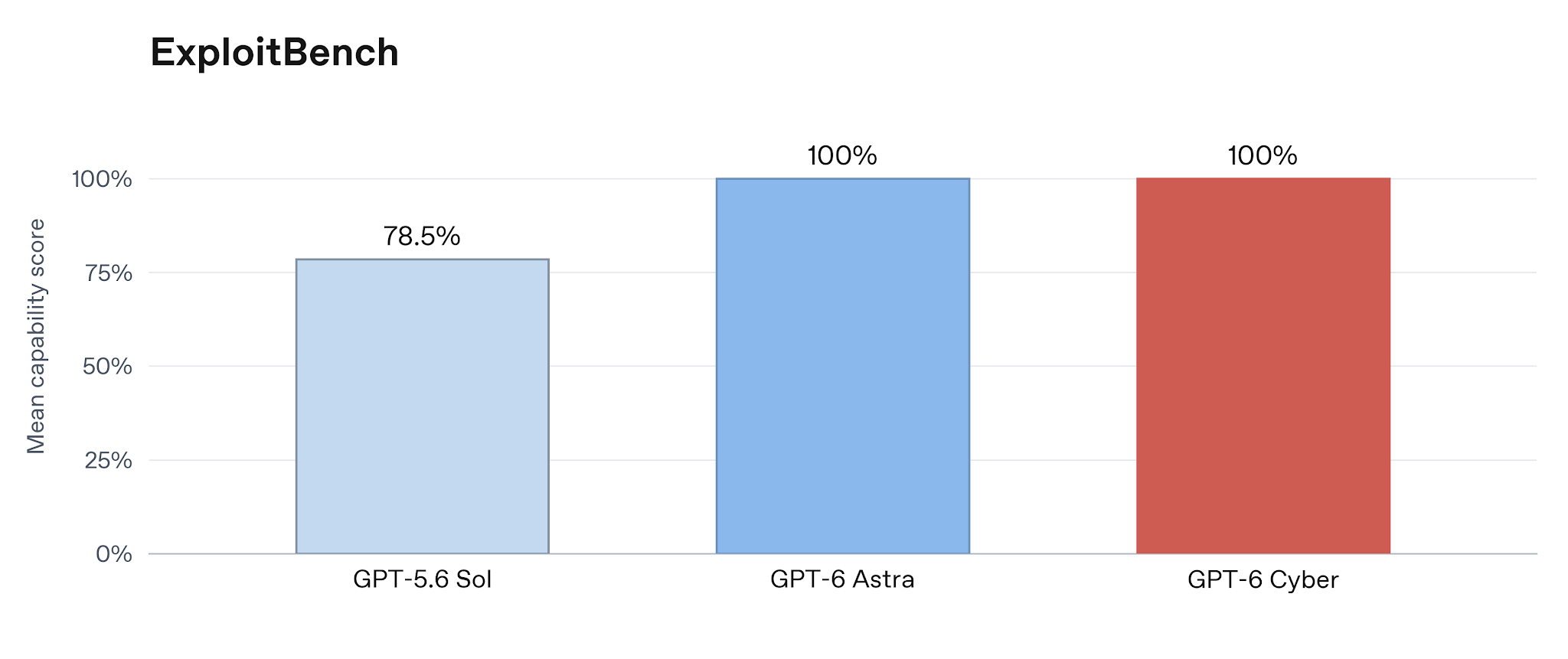
OpenAI reports that GPT-6 Cyber improves on GPT-5.6 Cyber and outperforms GPT-6 Astra on most cyber tasks, even when Astra does not refuse the request. Those are vendor results. This article has not run an independent benchmark, and official rows are not uniformly in Cyber’s favor.
| Comparison | GPT-6 Cyber | GPT-6 Astra | GPT-5.6 Cyber |
|---|---|---|---|
| Access | Daybreak Red plus separate model approval | Mainline flagship; reduced cyber refusals need Daybreak Red | All Daybreak Red organizations |
| Official Standard short-context list rate, per 1M tokens | $20 input / $100 output | $10 / $50 | $12.50 / $75 |
| ExploitGym intended-exploit success, OpenAI | 48.45% (announcement: 48.5%) | 42.43% | 32.1% |
| FrontierCyber, Irregular via OpenAI | 90 / 288 | 96 / 288 | Not listed in the same system-card table |
| ExpertSWE, OpenAI | 82.95% | 83.24% | Not listed in the same comparison |
| Official fit | Specialized, approved cybersecurity work | General hardest-work flagship | Red-eligible predecessor Cyber model |
OpenAI also reports a 51% relative ExploitGym gain versus GPT-5.6 Cyber. GPT-6 Cyber and GPT-6 Astra receive the same official Preparedness labels: Critical in cybersecurity, High in biological and chemical capability, and below High in AI self-improvement. For the general-purpose Sol versus Astra choice, see GPT-6 Sol vs Astra.
When to Use GPT-6 Cyber, Astra, or GPT-5.6 Cyber
Choose GPT-6 Cyber when your organization already has Daybreak Red and separate approval for this model, the work is authorized, and you need the specialized ID in Codex or an approved API project. Stay on GPT-5.6 Cyber if you are in Daybreak Red but are not approved for GPT-6 Cyber, or while you wait for OpenAI’s promised expansion, which still has no public date.
Use GPT-6 Astra, or a mid-tier such as Sol, for coding, agents, code review, and other work that does not require the Cyber ID. Daybreak Blue does not include cyber-specialized models. Reduced refusals on Astra require Daybreak Red, and even then Astra remains a mainline model. If a job already finishes on Sol or Astra, the Cyber gate and list rate are hard to justify. Compare a mid-tier option with the flagship in GPT-6.1 Sol vs GPT-6 Astra.
What to Use If You Are Not Approved
If you lack Daybreak Red or GPT-6 Cyber approval, the next useful step is the general GPT-6 line your account already offers, not a workaround.
For everyday writing, research, document work, and coding help, MyClaw Chat is a separate product. On the chat page, you describe a goal, add files or research when needed, choose a model or let routing pick one, and refine the result in the same workspace. Available tools can depend on your account and plan. GPT-6 Cyber is not listed or confirmed on MyClaw. Do not treat Chat as a way to reach this OpenAI ID.
Conclusion
GPT-6 Cyber is a restricted, paid Daybreak Red model with its own approval, not a public preview and not a drop-in substitute for GPT-6 Astra. The official API ID is gpt-6-cyber. OpenAI introduced it on 5 November 2026 for a select group of approved customers, with a later expansion that still has no date. Recheck live access, project setup, and official list rates before you budget. If you do not have approval, use Astra or Sol for general work and wait for official access rather than assuming another host can provide the Cyber ID.
Skip the Setup, Run Best-in-Class AI Agents Now
Launch a managed OpenClaw or Hermes Agent workspace in minutes, with always-on hosting, updates, and support handled by MyClaw.