Kimi K3.1 Pro vs Fable 5.1: Index Score, Cost per Task and Speed

By Olivia Hart
MyClaw Editorial
MyClaw
Run Best-in-Class AI Agents Now
Run OpenClaw or Hermes Agent on managed MyClaw hosting, so your AI agent stays online, updated, and ready for real work.
AI Takeaway
- Who leads Artificial Analysis Index v5.0? Claude Fable 5.1 — about 47 at high vs 46 for Kimi K3.1 Pro; the board puts Fable near 50 at higher effort (independent, checked Oct 30, 2026). New v5 scale; not comparable to older Index posts.
- Where does cost per Index task come out lower? Kimi K3.1 Pro — about $3.68 vs about $7.54 for Fable at high, on $2/$10 vs $10/$50 per 1M tokens (independent and vendor, Oct 30, 2026).
- Which finishes Index tasks faster? Fable 5.1 at high — about 703s vs about 1642s, with higher output speed (~58 vs ~35 tokens/s) (Artificial Analysis, Oct 30, 2026).
- Do defaults change the matchup? Yes. Kimi defaults to max
reasoning_effort; Fable defaults to high adaptive effort (vendor docs, Oct 30, 2026). Untuned calls are not the same effort rung. - How do I keep a long agent job running overnight? Host it on MyClaw with OpenClaw or Hermes — always on, scheduled jobs, no server chores, and it works with most popular models.
Effort Defaults: Max Thinking vs High Adaptive
List price alone does not settle Kimi K3.1 Pro vs Fable 5.1 — effort moves the bill and the wait, and the defaults sit at opposite ends.
Kimi K3.1 Pro always thinks. Moonshot's API (checked Oct 30, 2026) exposes reasoning_effort as low, high or max, applies max when you omit it, and keeps thinking on. It landed Oct 23, 2026 as the first K3.1-series release: a post-trained Kimi K3 MoE (~2.8T total / 104B active) with a 1M-token context. Our Kimi K3.1 Pro review covers access, Highspeed and pricing. Moonshot has also stated that full weights are promised by Nov 4, 2026 (vendor-stated; not released as of research day).

Claude Fable 5.1, released Sep 1, 2026 under claude-fable-5-1, keeps adaptive thinking on and defaults effort to high. Anthropic still points most workloads at Opus 5.5 first and reserves Fable for long-horizon coding and research when high-effort Opus fails. Our Fable 5.1 review walks through that guidance.
An untuned call sends Kimi to its ceiling and Fable to high. AA rows below use Fable at high as the near-default baseline; xhigh lifts the Index toward ~50 and raises cost and time per task.
Kimi K3.1 Pro vs Fable 5.1 Side by Side
Price, release and default rows are vendor-stated (Oct 30, 2026). AA rows are independent Artificial Analysis figures from the same day, Fable at high. Our earlier Kimi K3.1 Pro vs Opus 5.5 used pre-v5 Index numbers; this page uses Index v5.0 only (new scale ~Oct 28, 2026) — do not mix the two.
| Kimi K3.1 Pro | Claude Fable 5.1 | |
|---|---|---|
| Lab / release | Moonshot / Oct 23, 2026 | Anthropic / Sep 1, 2026 |
| List price in / out, 1M tokens | $2 / $10 | $10 / $50 |
| Cache read, 1M tokens | $0.20 | $0.25 |
| Context / max output | 1M / large vendor default | 1M / 128K |
| Default effort | Max | High |
| AA Index v5.0 (Fable high) | 46 | 47 |
| AA cost per task | $3.68 | $7.54 |
| AA time per task | ~1642s | ~703s |
| AA output speed | ~35 tok/s | ~58 tok/s |
| AA TTFT | ~2.96s | ~6.45s |
| Downloadable weights | Promised by Nov 4, 2026 | Closed |
Fable's TTFT looks slower than Kimi's, yet whole tasks finish sooner because Fable streams faster on the Index mix — treat TTFT as time to the first answer token after thinking. On OpenRouter catalog pages the same day, third-party provider metrics showed Kimi on Moonshot at roughly 4.7s P50 / ~26 tokens/s (Highspeed near 3.6s / ~54 tokens/s at double list) and Fable on Vertex near 2.15s / ~70 tokens/s (OpenRouter, not AA).

Where Each Model Wins on Independent Tests
Artificial Analysis's v5.0 sub-scores (independent, Oct 30, 2026) split the field.
Kimi leads on terminal and automation: Terminal-Bench 4.0 67% vs 52%, AutomationBench-AA 73% vs 55%, with AA-Briefcase and GDP.pdf also leaning Kimi. Fable leads on knowledge and science: HLE-Diamond 50% vs 37%, plus CritPt, AA-Omniscience, FrontierCode 2.0 and Terminal-Bench-Science. Treat vendor tables as self-reported; use the independent Index as the shared ruler. For another Fable-side frame, see GPT-6 Astra vs Fable 5.1.
Cost per Task, List Rates, and OpenRouter Speed
On the sticker, Fable's list rate is five times Kimi's on input and output ($10/$50 vs $2/$10 per 1M). Cache reads sit close at $0.20 vs $0.25 (vendor sheets, Oct 30, 2026). Highspeed doubles Kimi's list to $4/$20.
The bill that matters for agent loops is cost per task. Artificial Analysis counted about $3.68 per Index task for Kimi against about $7.54 for Fable at high (independent, Oct 30, 2026). Turning Fable to xhigh lifts the Index toward ~50 and cost per task toward about $10.85 — only if you raise effort past the default.
If you are already on Kimi K3, our Kimi K3.1 Pro vs K3 comparison covers the one-line ID swap and the unchanged API contract.
Keep Long Agent Jobs Online: MyClaw in 3 Steps
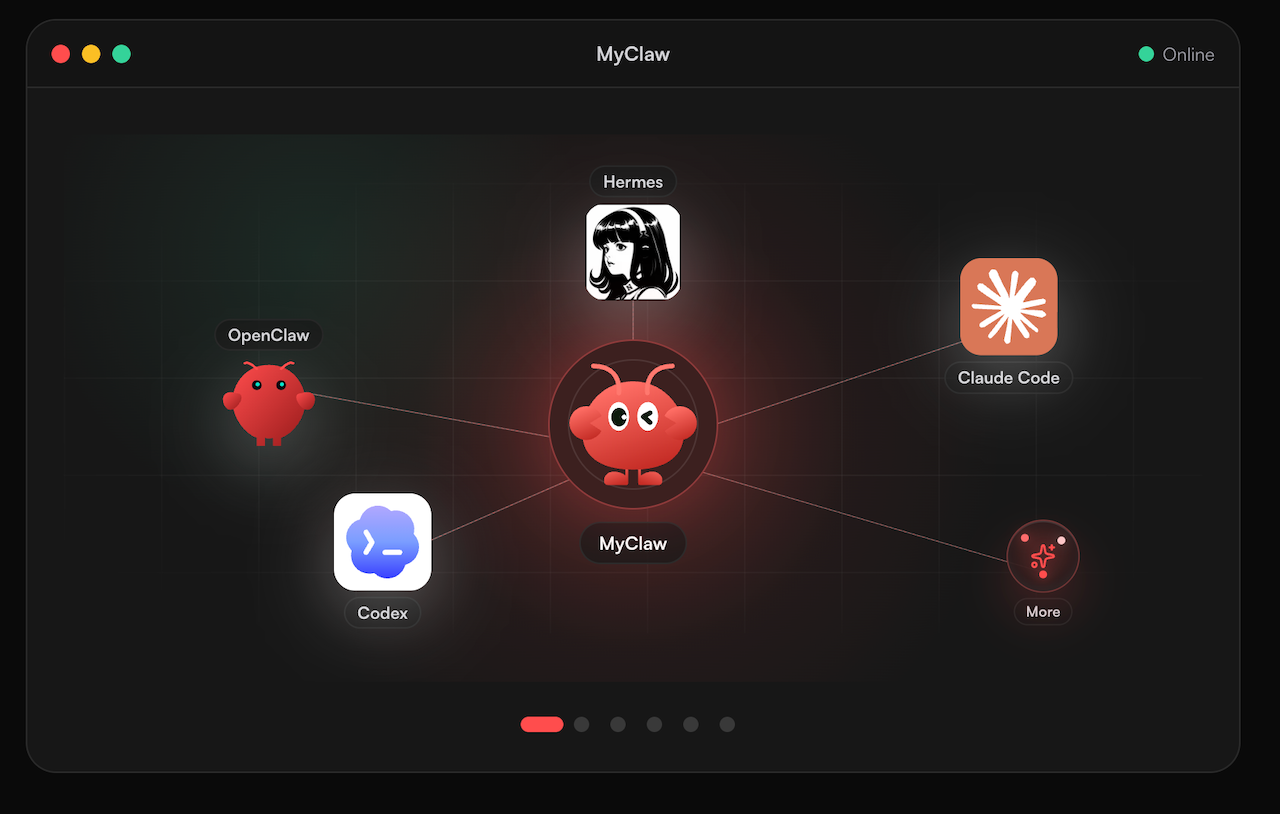
Index rows only sketch the field. Long agent jobs fail when the laptop sleeps or nobody is watching overnight.
MyClaw hosts managed OpenClaw or Hermes agents for that layer: setup and upkeep handled, always on, scheduled jobs after you log off, no server to build or patch. Agents here work with most popular models. MyClaw does not make the models; it keeps the runtime online so the model you pick can finish the job. See what OpenClaw is for the framework side.
- Pick one recurring job — a nightly coding agent, a research digest or a document pipeline — and write the brief you would give a teammate.
- Launch a MyClaw workspace, choose OpenClaw or Hermes, and point the agent at the model you want.
- After a week, compare answers kept, retries needed and hours you got back.
Keep the setup that clears your bar.
Routing Guide: Which Tasks to Send Where
Split routing usually beats one default.
Send to Kimi K3.1 Pro when budget-bound batch agents dominate, terminal and tool-heavy coding map to your jobs, document extraction leans on the AA-Briefcase pattern, or you may self-host once Moonshot's Nov 4, 2026 weight pledge (vendor-stated) ships.
Send to Claude Fable 5.1 when long-horizon coding outruns Opus 5.5 at high effort, knowledge- and science-heavy research tracks HLE-Diamond more than Terminal-Bench, your stack already sits on Anthropic / Bedrock / Vertex / Foundry, or wall-clock time matters more than the sticker gap.
Run the same ticket on both for a week. Pin effort — max Kimi next to high Fable is closer to production defaults than max against xhigh.
Kimi K3.1 Pro vs Fable 5.1 Verdict
- Index v5.0: Fable 5.1 leads — about 47 at high, near 50 on the board / xhigh — against Kimi at 46 (Artificial Analysis, Oct 30, 2026).
- Cost per task: Kimi K3.1 Pro comes out lower on the Index mix (~$3.68 vs ~$7.54 at Fable high).
- Wall-clock per task: Fable 5.1 at high finishes sooner (~703s vs ~1642s) despite a slower TTFT.
- Defaults: Untuned Kimi runs at max; untuned Fable runs at high — pin effort before you crown a winner.
- Always-on host: Park recurring jobs on a managed OpenClaw or Hermes agent so the model choice survives overnight runs.
Kimi K3.1 Pro vs Fable 5.1 Conclusion
Kimi K3.1 Pro vs Fable 5.1 is a three-way fork among Index need, cost per task and wait time. On Artificial Analysis Index v5.0 (checked Oct 30, 2026), Fable edges the headline score at high effort and pulls further ahead when effort rises; Kimi posts the lower cost per task and stronger terminal/automation rows on a $2/$10 list.
Match the meter to the job: Kimi for budget-bound agent batches and tool-heavy terminal work; Fable 5.1 when long-horizon coding or knowledge-heavy research outruns Opus 5.5, or when your stack already sits on Anthropic's clouds. Re-check dated AA v5.0 figures before you lock a quarterly default — the scale changed in late October 2026.
When the table still feels abstract, trial both IDs on two weekly roles, then park one recurring job on a hosted OpenClaw or Hermes agent so the winner keeps running overnight.
Skip the Setup, Run Best-in-Class AI Agents Now
Launch a managed OpenClaw or Hermes Agent workspace in minutes, with always-on hosting, updates, and support handled by MyClaw.