MiniMax M3.1 Flash vs M3: Price, Speed, Benchmarks Compared

By Nathan Cole
MyClaw Editorial
Compare in MyClaw
Compare MiniMax M3.1 Flash and MiniMax M3 on your own work
Run the same task in both models to compare quality, tool behavior, speed, and cost per accepted result before migrating.
AI Takeaway
- How do the two models differ at the core? MiniMax M3 (API ID MiniMax-M3) launched on June 1, 2026 as the open-weight flagship of the M3 generation. MiniMax M3.1 Flash (MiniMax-M3.1-Flash) arrived on October 19, 2026 as a faster model tuned for agent work, with weights promised for a later date (vendor-stated, checked October 20, 2026).
- How do their prices compare? M3.1 Flash lists a flat $0.15 for each million tokens in and $0.60 for each million out. M3 Standard lists $0.30 in and $1.20 out for prompts up to 512K tokens, with higher rates above that and a Priority tier at 1.5 times Standard (vendor-stated, October 20, 2026).
- Does either have a bigger context window? No. Both list a 1,000,000-token window and accept text, images and video as input.
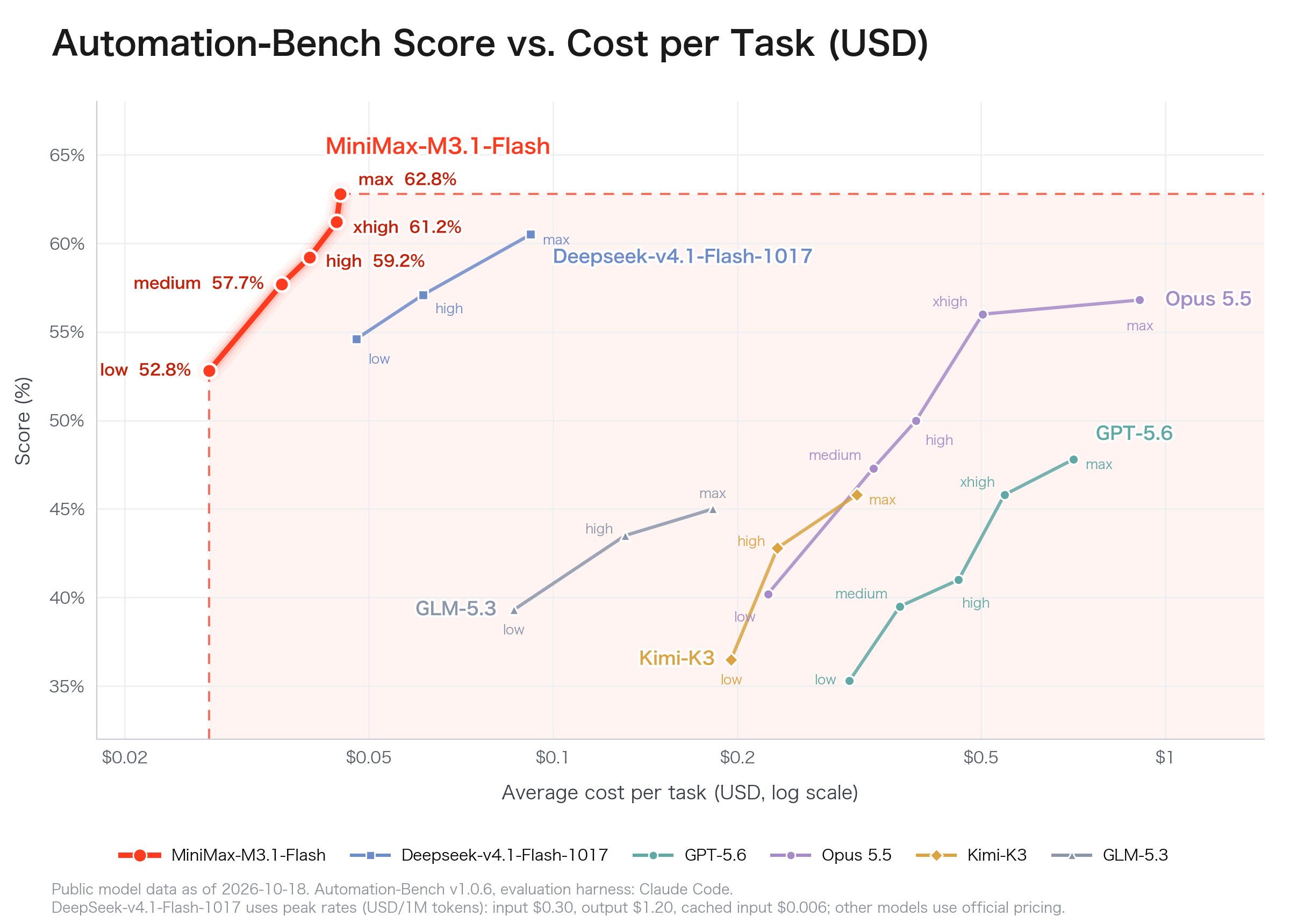
- Which one scores higher? MiniMax reports each model on different benchmarks, so there is no direct vendor comparison. On the Intelligence Index from Artificial Analysis, M3.1 Flash landed at roughly 42 or 43, well up from M3's 29 (third-party, published October 19, 2026).
- Can I try both in MyClaw? Yes. Both MiniMax-M3 and MiniMax-M3.1-Flash are available there, so you can hand the same task to each and judge for yourself.
Side-by-Side Specs: M3.1 Flash and M3
The MiniMax M3.1 Flash vs M3 decision starts with the basics below. Every row is vendor-stated and was checked on October 20, 2026.
| Spec | MiniMax M3 | MiniMax M3.1 Flash |
|---|---|---|
| API model ID | MiniMax-M3 | MiniMax-M3.1-Flash |
| Release | June 1, 2026 | October 19, 2026 |
| Status | Generally available | Generally available |
| Weights | Open on Hugging Face | Not yet released, promised later |
| Size | About 428B total, 23B active (model card) | Not disclosed |
| Max context | One million tokens | One million tokens |
| Input types | Text, image and video | Text, image and video |
| Reasoning control | Not detailed in sources read | Always on; effort low to max |
| Service tiers | Standard and Priority | One flat rate |
The biggest structural difference is weights. M3 can be downloaded and self-hosted right now, while M3.1 Flash is API-only until MiniMax publishes its weights. For a deeper profile of the older model alone, see our MiniMax M3 guide.
Run Both Models Side by Side in MyClaw
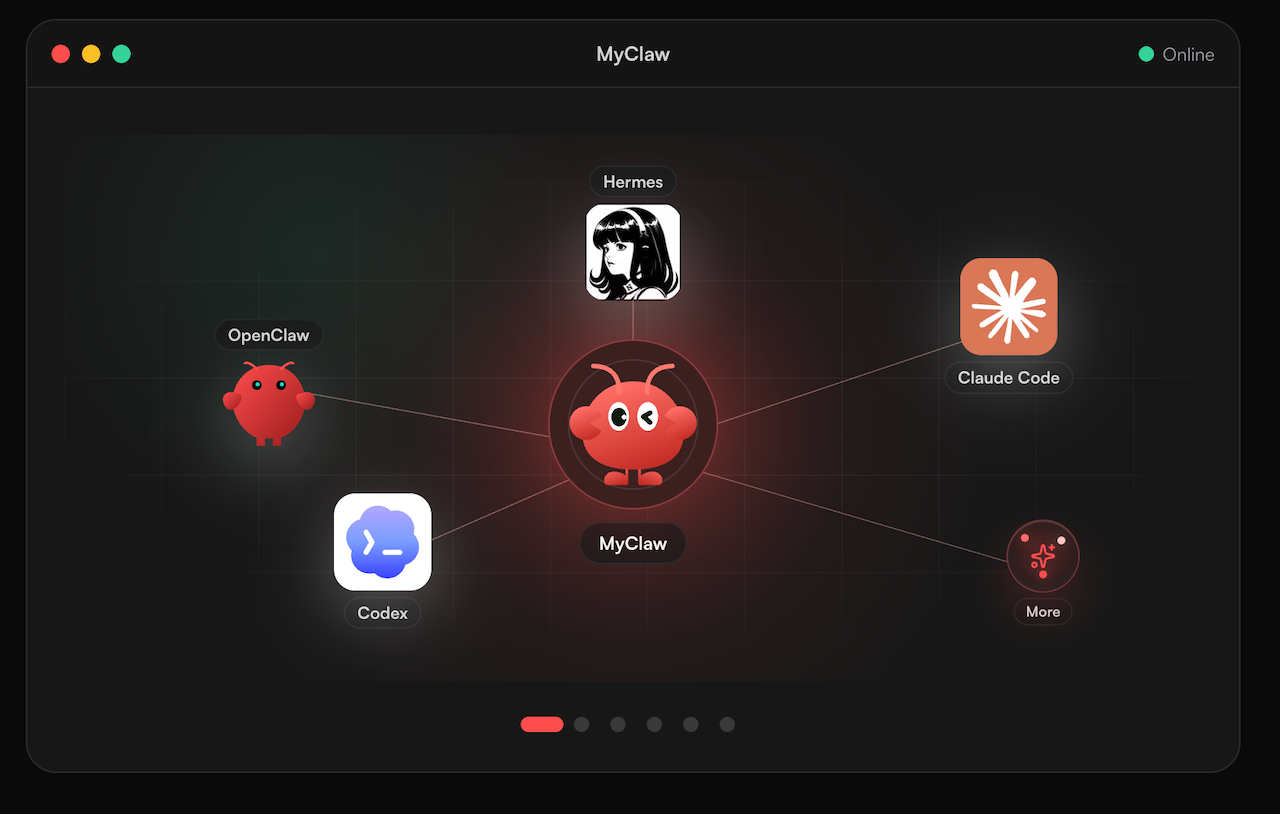
Benchmarks only go so far. The most useful test is your own work: one prompt, two models, results next to each other. With MyClaw you get an OpenClaw- or Hermes-based agent, hosted for you and online all day, that replies over email, Telegram and WhatsApp or inside a browser window. The platform works with most popular models; that includes both MiniMax M3 and MiniMax M3.1 Flash, which makes a fair A/B run simple to set up.
If you want to understand the agent frameworks first, our OpenClaw introduction and Hermes overview are good starting points.
- Sign up and launch your MyClaw agent.
- Pick MiniMax M3 (MiniMax-M3) in the model settings and give it one genuine job you need done this week.
- Switch to MiniMax M3.1 Flash (MiniMax-M3.1-Flash), send the identical task, and compare quality and speed.
Price: What the Same Job Costs on Each
Here is MiniMax M3.1 Flash vs M3 pricing per million tokens, vendor-stated and checked on October 20, 2026.
| Rate per 1M tokens | M3 Standard, up to 512K input | M3 Standard, above 512K input | M3.1 Flash |
|---|---|---|---|
| Input | $0.30 | $0.60 | $0.15 |
| Output | $1.20 | $2.40 | $0.60 |
| Cached input read | $0.06 | $0.12 | $0.015 |
M3's Priority tier gives faster admission and steadier reliability at 1.5 times the Standard rates, switched on with a service tier setting. M3.1 Flash has a single rate whatever the prompt length.
Now our own arithmetic, using list prices and ignoring caching. These are illustrations, not vendor quotes:
- A 200K-token prompt with a 20K-token reply: roughly $0.084 on M3 Standard, $0.126 on M3 Priority and $0.042 on M3.1 Flash.
- A 700K-token prompt with a 30K-token reply: roughly $0.492 on M3 Standard, assuming the whole request bills at the above-512K rate, against about $0.123 on M3.1 Flash.
Why the gap? M3.1 Flash's list rates are lower on every line, and M3 bills long prompts at double its base rate, so the difference grows with prompt size.
Two caveats: M3.1 Flash always reasons, and those reasoning tokens bill as output, so heavy effort settings push real costs up. And long prompts are where the gap widens most, because only M3 steps up in price past 512K. Our M3.1 Flash review covers the newer model's pricing and effort settings in more depth.
Speed and Efficiency
MiniMax frames M3.1 Flash as a speed release. It claims online inference nearly three times faster than its predecessor, roughly 70% less spent per agent task, output above 200 tokens per second at peak and a median above 170 (vendor-stated, October 20, 2026).
M3's speed story is about long context. Its model card credits MiniMax Sparse Attention with 9x faster prefill and 15x faster decoding than M2 at a 1M-token context, with per-token compute cut to one twentieth (vendor-stated). For agents, latency compounds: a ten-step job waits on ten separate model calls, so per-call speed matters more than it does in a single chat reply. So both models are efficient at scale, but M3.1 Flash is the one pitched for quick turnaround on many short agent steps. Our M2 vs M3 breakdown explains what that attention change meant for the previous jump.
Independent data points the same way for the MiniMax M3 vs M3.1 Flash efficiency question. Artificial Analysis reported that M3.1 Flash cut the average cost of an Intelligence Index task from about $0.51 on M3 to about $0.22 (third-party, October 19, 2026).
Benchmarks: Separate Vendor Tables and One Shared Yardstick
M3 Vendor Scores
| Test | M3 score |
|---|---|
| SWE-Bench Pro | 59.0% |
| Terminal-Bench 2.1 | 66.0% |
| MCP Atlas | 74.2% |
| MMMU-Pro | 78.1 |
Source: MiniMax launch post and model card, vendor-stated, checked October 20, 2026.
M3.1 Flash Vendor Scores
| Test | M3.1 Flash score |
|---|---|
| DeepSWE v1.1 | 73.7% |
| OSWorld V2 | 61.7 |
| BankerToolBench | 76.2 |
| CyberGym | 82% |
Source: MiniMax launch post, vendor-stated, checked October 20, 2026. The two tables use different tests, so comparing a score in one with a score in the other would mislead.
Third-Party Head-to-Head
Artificial Analysis gives the only shared yardstick we found. Its index put the newer model in the low 40s (reports differ between 42 and 43) versus 29 for M3. Humanity's Last Exam showed 48% versus 39% (both third-party figures, dated October 19, 2026). The same testing flagged that M3.1 Flash often guesses instead of admitting it does not know, so build in a fact check for knowledge-heavy work.
Pros and Cons of Each Model
Pros: MiniMax M3.1 Flash
- Lower listed rates at every prompt length.
- Higher third-party index score.
Cons: MiniMax M3.1 Flash
- No downloadable weights yet (vendor-stated).
- Reasoning cannot be switched off.
Pros: MiniMax M3
- Open weights available now.
- Priority tier for steadier responses.
Cons: MiniMax M3
- Higher rates, rising past 512K input.
- Lower third-party index score.
Which to Pick and How to Migrate
In our judgment, the choice in MiniMax M3 vs M3.1 Flash comes down to a few questions:
- Running many agent steps through the API? M3.1 Flash, for its lower listed rates and speed claims.
- Need to self-host or fine-tune today? M3, since its weights are already public.
- Need guaranteed fast admission at peak times? M3's Priority tier is the only listed option.
- Feeding very long prompts? Run the numbers above, as M3's price climbs past 512K tokens.
None of this replaces a trial. A model that wins on paper can still fumble your particular prompts, tool schemas or file types, so treat the list above as a shortlist, not a verdict.
Moving an existing M3 integration to M3.1 Flash is mostly a settings job, based on MiniMax's docs:
- Change the model ID from MiniMax-M3 to MiniMax-M3.1-Flash.
- Choose an effort level; thinking has no off switch, and MiniMax's docs say attempts to do so are rejected.
- Read the final answer and the reasoning from their separate response fields.
- Re-run your own evaluation set and compare accuracy, latency and token use.
If you read our earlier M3.1 Flash Preview write-up, note that the released model now has published prices and a new model ID.
Conclusion
The MiniMax M3.1 Flash vs M3 question has a fairly clear answer for most API users: M3.1 Flash lists lower rates, claims more speed and scores higher in independent testing, though it tends to guess when unsure. M3 still earns its place if you need open weights now, a Priority tier, or a model you can run on your own servers. Whichever way you lean, put both through a week of your actual tasks before you commit.
Compare in MyClaw
Compare MiniMax M3.1 Flash and MiniMax M3 on your own work
Run the same task in both models to compare quality, tool behavior, speed, and cost per accepted result before migrating.