Muse Spark Open vs GLM 5.3: Which Open-Weight Model Fits Your Agents?

By Julian Brooks
MyClaw Editorial
MyClaw
Run Best-in-Class AI Agents Now
Run OpenClaw or Hermes Agent on managed MyClaw hosting, so your AI agent stays online, updated, and ready for real work.
AI Takeaway
- What are these two models? Muse Spark Open means the open-weight edition of Meta's Muse Spark, with 816B parameters in total and 42B active, released October 15, 2026. GLM-5.3 is Z.ai's flagship for coding and agents, announced August 14, 2026, and Hugging Face shows roughly 753B parameters (vendor-stated).
- Which one handles more input types? Muse Spark Open reads text, pictures, video and audio and replies in text. Z.ai's documentation says GLM-5.3 accepts text only, with a one-million-token window and a 128K-token output cap.
- How close are the API prices? For GLM-5.3, Z.ai lists $1.40 on input, $0.26 on cached input and $4.40 on output, per million tokens (vendor-stated). Third-party listings for hosted Muse Spark Open show $1.25, $0.15 and $4.25 (October 2026), a narrow gap.
- Who shows better published evidence? Z.ai posts a long benchmark table on its model card, produced with its own setups. We found no comparable table from Meta and no neutral head-to-head, so we name no winner.
- Is there a hosted-agent route? MyClaw offers general hosted OpenClaw and Hermes agents, described at the end. We do not say either model runs there.
Muse Spark Open vs GLM 5.3: The Quick Comparison
Both are big open-weight models pitched at coding and agent tasks. They differ in input types, licensing and how much evidence each maker publishes. No hands-on testing went into this, so every figure comes from vendor pages or third-party listings, dated. Our companion Kimi K3 matchup sets the same Meta model against another rival.
| Muse Spark Open | GLM 5.3 | |
|---|---|---|
| Maker | Meta | Z.ai |
| Date | October 15, 2026 | August 14, 2026 |
| Size | 816B total, 42B active | about 753B total |
| Context window | Roughly 1M tokens | Roughly 1M tokens |
| Accepts | Text, pictures, clips, sound | Text only |
| License | Muse Model License | GLM-5.3 License |
| Listed API price | $1.25 in, $4.25 out | $1.40 in, $4.40 out |
The table makes the pattern plain. Size, window and price are near twins, so the real separators are modality and paperwork: Meta's model reads more kinds of input, while Z.ai's comes with a license text and benchmark card that are easier to inspect. If your project never touches images, video or audio, that first difference may not matter to you at all, and the second one probably will.

What Muse Spark Open Offers
Here "open" means the downloadable edition of Meta's Muse Spark, not a separate family. Meta aims it at coding and agentic tasks. The weights come in BF16 and NVFP4 forms, with extra safety training because the weights run outside Meta's own guardrails.
Its showpiece is a pair of Apple M5 Ultra Mac Studios. Meta says the weights run on engines such as SGLang, vLLM, TensorRT-LLM, Transformers, MLX, llama.cpp and Unsloth, so tooling choice is wide. API hosts Meta names include Together, Fireworks, Baseten and OpenRouter, and its license carries what Meta calls "limited commercial terms". For the closed original, read Meta's Muse Spark in review.
What GLM 5.3 Offers
Z.ai says GLM-5.3 shares GLM-5.2's base model and that every improvement came from post-training. It claims a 50 percent gain over GLM-5.2 on its in-house coding benchmark. Reasoning is always on, with three effort settings, and max is both the default and Z.ai's pick for coding.
The weights sit on Hugging Face, and Z.ai also sells API access plus a points-based Coding Plan. The same price page lists lighter siblings, GLM-5.3-Flash at $0.15 in and $0.50 out and GLM-5.3-FlashX at $0.37 and $1.25 (vendor-stated, October 16, 2026), which matter if some of your work needs less power. Our GLM 5.3 versus GLM 5.2 post digs into the step up from the previous generation.
Open Weights, Licenses and Self-Hosting
The next paragraph is a plain summary of both licenses, not legal advice. The GLM-5.3 License, which we read on October 16, 2026 at the model's Hugging Face repository, gives broad rights to use, change, share and sell the software. A company running a Model-as-a-Service business with more than $10 billion in revenue across 12 months must clear a Z.ai security review first. For Muse Spark Open we only have Meta's own phrase, "limited commercial terms", and have not read the full text.
For hardware, Meta puts the 4-bit build at about 537 GB of weights, suited to four Blackwell GPUs, or two Mac Studios. Z.ai names frameworks such as vLLM, SGLang and Transformers but gives no hardware figure we could confirm. Expect a serious cluster either way, and confirm the exact memory, interconnect and runtime support with each vendor before buying anything.
Benchmarks and Vendor Claims
The Z.ai model card reports 88.2 on Terminal Bench 2.1 and 66.9 on DeepSWE, using its own harness settings, and says the model reaches open-source state of the art on some coding suites. Read those as vendor-reported.
Meta describes strong long-horizon results and points to an evaluation methodology report, but we found no score table to quote. The two companies test differently, so a fair number-to-number comparison does not exist yet, and we offer none.
API Prices and Cost Notes
Z.ai's pricing page (read October 16, 2026) charges $1.40 per million tokens in, $0.26 for cached tokens and $4.40 on the way out for GLM-5.3. Third-party figures from OpenRouter, Together and Fireworks (OpenRouter rechecked October 16, 2026) list Muse Spark Open with $1.25 in, $0.15 cached and $4.25 out. Together offered a limited free promotion until October 18, 2026.
A quick illustration, our own arithmetic: sending 2 million uncached tokens and receiving 200,000 would list at $2.80 plus $0.88, which is $3.68, on GLM-5.3, and at $2.50 plus $0.85, which is $3.35, on a Muse Spark Open host. Real bills will move more with caching, reasoning length and provider than with these small gaps.
Muse Spark Open vs GLM 5.3 Pros and Cons
Pros for Muse Spark Open
- Takes pictures, video and audio alongside text.
- Lower active size and a documented desktop-cluster path.
- Several hosting partners to choose from.
Cons for Muse Spark Open
- Text-only output.
- Limited commercial terms in its license.
- Newer, with thinner outside testing.
Pros for GLM 5.3
- Detailed vendor benchmark table and clear API documentation.
- Adjustable reasoning effort, with a sibling Flash tier for lighter jobs.
- Broad license rights, with limits only for very large hosting businesses.
Cons for GLM 5.3
- Text-only input.
- Reasoning cannot be turned off.
- Benchmarks are vendor-run, so independent confirmation is still limited.
Picking by Job
Reach for Muse Spark Open if your work involves screenshots, video clips or audio, or if running a model on a small desktop cluster appeals. Reach for GLM 5.3 if you spend long sessions on text and code and like Z.ai's published numbers and adjustable effort.
On a tighter budget, our Muse Spark 1.3 versus GLM 5.3 Flash article covers the smaller models. Teams that need both vision and long coding runs might even use each model for the job it suits. Whichever you pick, try three of your real tasks first: one coding fix, one long document summary and one tool-calling workflow. Note retries, wall-clock time and total tokens used, because those three numbers tell you more than any vendor table. If either model needs screenshots or audio, add a fourth task that includes them.
Meet MyClaw, a Helpful Agent That Stays On
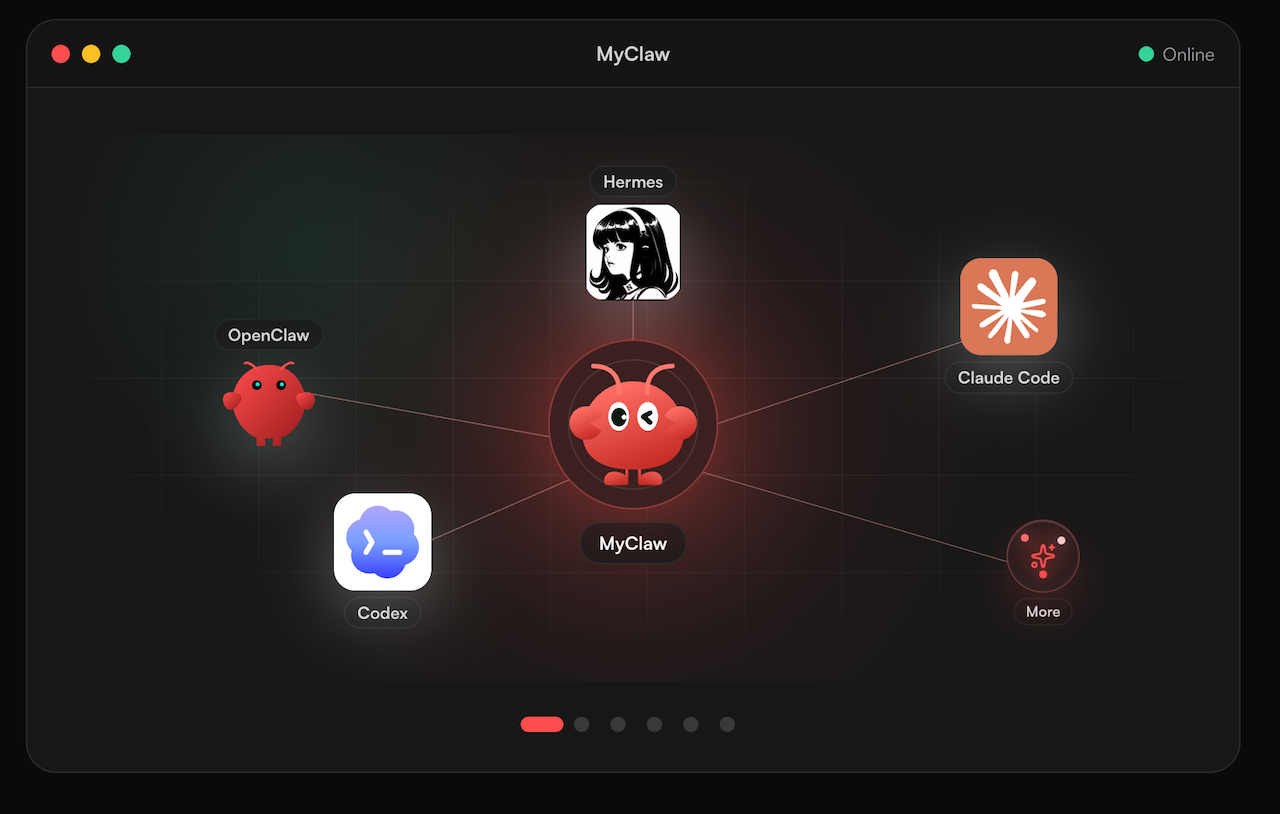
If picking a model feels like homework, here is a friendlier idea. MyClaw is a general-purpose agent that lives in the cloud, so you do not babysit a server. It is managed OpenClaw or Hermes under the hood, it stays on all day, and you can talk to it from your chat app or in a browser. It can also plug into your documents, apps and data.
It works with most popular models, and compared with Muse Spark it costs less, though we will not quote numbers here because they change. We are not saying Muse Spark Open or GLM 5.3 runs there. If you are curious, what OpenClaw is and the Hermes agent page are easy places to start.
- Sign up and spin up your own hosted agent.
- Once it is up, connect your chat app (Telegram, say) and point it at the documents or apps you want it to reach.
- Give it one little chore you repeat each day, such as a news roundup, and see how it feels.
Conclusion
The two models land near each other on size, context and listed prices, so the decision rests on inputs and evidence. Meta's model adds pictures, video and audio, while Z.ai's brings a detailed benchmark record and adjustable reasoning. Neither vendor offers a neutral test, so your own tasks are the fairest benchmark. Run both on your own tasks before committing, and if hosting chores sound tiresome, MyClaw's managed agents are an easy thing to look at next.
Skip the Setup, Run Best-in-Class AI Agents Now
Launch a managed OpenClaw or Hermes Agent workspace in minutes, with always-on hosting, updates, and support handled by MyClaw.